The reason owners look at this at all is the phone that rings with nobody to answer it. One call-tracking vendor found that 27% of calls to home services businesses go unanswered, and fewer than 3% of callers sent to voicemail leave a message (Invoca, vendor, 2024). That is home services as a whole, not pest control alone, but anyone who has run a pest control office in spring knows the shape of it. A caller with wasps by the back door often does not wait for a call back. They ring the next company.
Part of the Calls hub.
What a good AI receptionist does, step by step
Answers, and says what it is. It picks up promptly in the hours you set it to answer, and tells the caller it is an AI assistant for your company. Hiding that is how you lose trust on the first call.
Finds out who is calling. It looks the number up in your CRM. A current customer with a visit on Thursday needs a different call than a new homeowner.
Listens before it quotes. What pest, where in the house, for how long. A price given before the problem is understood is a guess.
Checks your service area before promising a visit. Promising a visit you cannot make is worse than not answering.
Quotes from your price list and nothing else. It should sell only the services you open to callers, at your prices. If it invents a price, it is not ready.
Closes the loop. Sends the agreement, books the visit into your real schedule and writes notes to the customer's account, so your office does not retype anything in the morning.
Knows when to hand off. Callers who ask for a person go to your team: live during the hours you set, as a message outside them.
Leaves a record. Each call, and what came of it, somewhere your office can read the next morning.
What it should never do
- Pretend to be a person.
- Promise a visit outside your area, or a time your schedule does not have.
- Make up prices, discounts or guarantees.
- Argue with an upset customer or a billing dispute.
- Keep a caller from a person they asked for during your office hours.
What good looks like after a month
Judge any answering setup, human or AI, by what it does for your callers and your office, not by how it sounds in a demo.
- Fewer calls nobody picks up. Aim for almost no new caller reaching voicemail after hours or at lunch. Watch unanswered calls per week, by hour of the day.
- More first visits booked from calls. A call that ends in a booked visit and a sent agreement is the outcome you are paying for. Watch booked first visits from calls each week.
- No promises you cannot keep. Visits only inside your area, prices only from your list. Watch complaints and refunds that start with "they told me on the phone".
- A person when the caller wants one. Callers who ask for your team reach it in office hours, or get a call back the next morning. Watch next-morning callbacks and how fast they happen.
- A record the office can trust. Every call and its result is in one place, so nothing is retyped. Watch how often the office has to call a customer back to ask what was said.
If a vendor cannot show you these numbers for your own calls, keep looking.
What missed calls cost
Do the math on your own phone. The inputs below are invented except the two published rates.
Example: one month of calls at Demo Pest Control
Example data. Every input except the 27% and the 3% is an assumption for illustration.
| Line | Example: Demo Pest Control | Your numbers |
|---|---|---|
| What we assume | ||
| Calls in a monthAssumption | 500 | |
| Share of calls unansweredInvoca, vendor, 2024, home services, not pest control alone | 27% | |
| Share of unanswered calls that reach voicemailAssumption | 100% | |
| Share of voicemail callers who leave a messageInvoca, vendor, 2024 ("under 3%") | 3% at most | |
| Share of unanswered callers who wanted new serviceAssumption | 20% | |
| Share of those you would have signed if answeredAssumption | 30% | |
| First-year value of a new customerAssumption | $500 | |
| Working it out, row by row | ||
| 1Unanswered calls500 × 27% = | 135 | |
| 2Callers who leave a message135 × 100% × 3% = | 4 at most | |
| 3Unanswered callers who wanted new service135 × 20% = | 27 | |
| 4New customers lost27 × 30% = | 8.1 | |
| 5First-year revenue lost in one month8.1 × $500 = | $4,050 | |
The example ignores the few who leave a message and are called back, and the current customers who call about a visit. Both matter, but neither changes the point: the gap is in the calls nobody picks up.
Before you switch one on
- Decide your office hours for transfers. When should a caller reach a person, and on which number?
- Decide what may be sold on a call. Which services, and at what prices.
- Decide what it may promise. Write down what callers may not be promised, and share it with the office.
- Read the first week of calls. All of them. You will learn more about your callers than from a month of call logs.
Answering is only the first step with a new caller. What happens to the quote afterwards is in Pest control leads: from first call to first visit. More reading: AI for pest control companies and pest control appointment reminders customers answer.
Questions
Should an AI receptionist say it is AI?
Can an AI receptionist book pest control appointments?
Is an AI receptionist the same as an answering service?
How do I test one before I buy?
If you use Sellify
Sellify does not replace your office: during the hours you set, it transfers callers to your team, and outside them it takes a message. Inbound Voice answers calls after hours and when the office is busy, and says it is an AI assistant. It looks up the caller, checks the service area, quotes from the offers you set, sends the agreement, books or moves the visit and writes notes to your CRM. Your office can listen to each call and see how it ended.
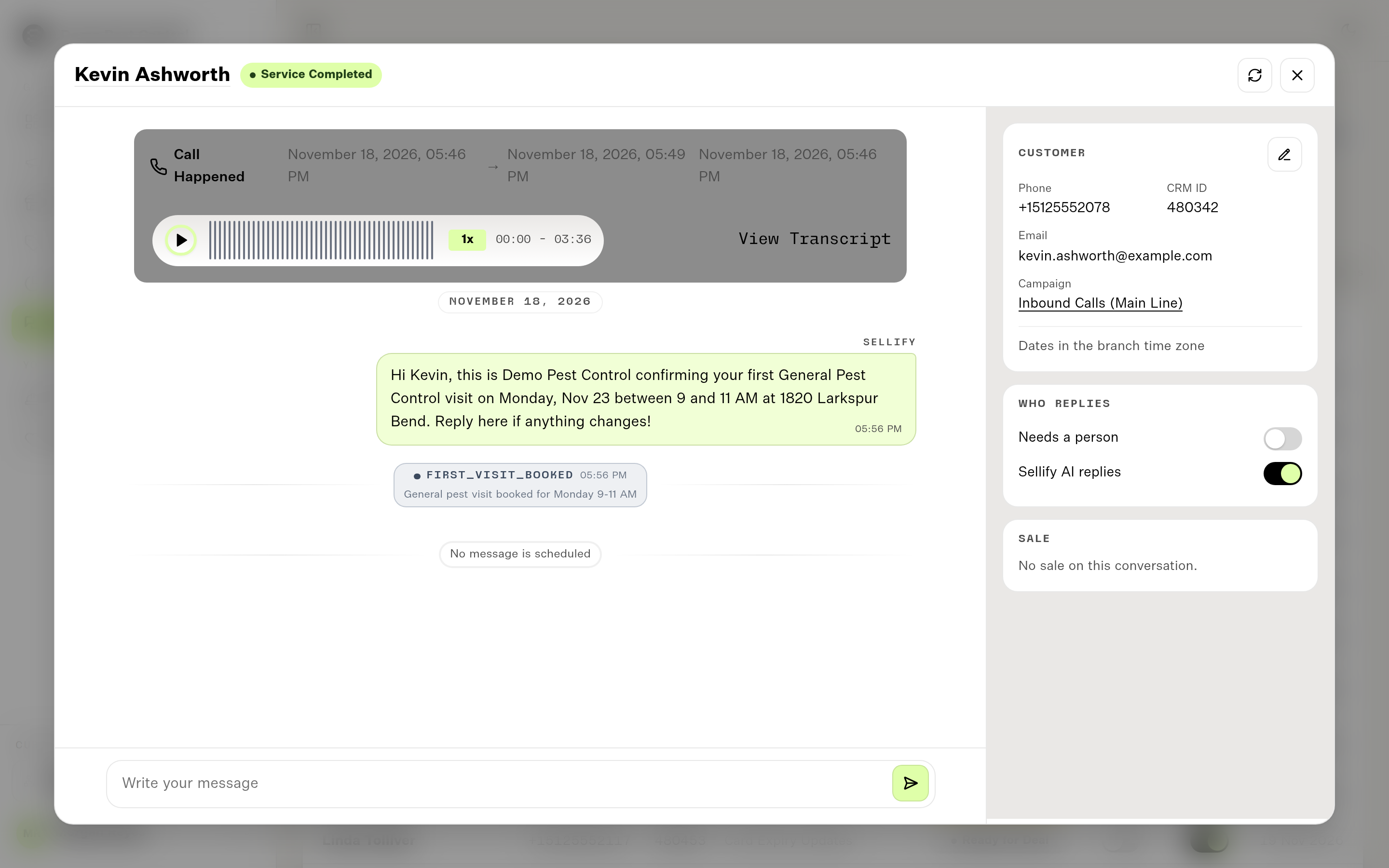
Call your own main line three times after hours: as a new customer, as a current customer moving a visit, and asking for a person. Write down what went well and what did not.
Sellify AI does this texting and call answering for pest control companies. See how it works, or book a walkthrough.