The work is not going away. The US Bureau of Labor Statistics counts 108,700 pest control worker jobs in 2025 and projects 6% growth to 2035, with about 13,700 openings a year, many of them to replace workers who leave (US Bureau of Labor Statistics, 2025 data). And people are the bottleneck: 36.8% of surveyed pest control owners and managers said too few technicians held back their company's growth (Specialty Consultants via NPMA, 2026). The useful question is not "will AI do the job" but "which hours of my people's day should it take off their hands."
This is the pillar guide for the AI, calls and texting cluster, part of the Calls hub.
Where AI fits in a pest control company
Most of an office's day is hundreds of small conversations. Some win the first sale: answer the phone at 8 PM, quote the caller, follow up the quote nobody called back. Others keep the customer: confirm the visit, pass the gate code, ask how it went, fix the card, chase the balance.
Those conversations share three traits that suit AI:
- They repeat. The same few questions, every day, for every customer.
- They are time-sensitive. A reminder the day after the visit is useless; a call answered tomorrow is a lost customer.
- They mostly end well without a person. "Yes, Tuesday works." "Updated, thanks." The few that need a person can be handed over.
Work that does not fit: anything physical, anything that needs a license, and anything where the right answer depends on judgment and relationship. A dispute about a charge, a commercial contract negotiation, a technician who is struggling: those stay with people.
Myths and facts
AI will replace pest control technicians.
Pest control jobs are projected to grow 6% from 2025 to 2035, with about 13,700 openings a year. AI takes on conversations; it does not treat a crawlspace.
Source: US Bureau of Labor Statistics, 2025 dataAI in pest control is only about getting new leads, or only about keeping customers.
It is both. The same repeating conversations win a first sale (a new caller answered, a quote followed up) and keep a customer on service (a visit confirmed, a card fixed).
Source: Practice, no statisticAI will say whatever it wants to my customers.
With a well-built tool, you decide the hours it may text and what it may offer and promise, and your team can read any conversation and take it over.
Source: Buyer's advice, not a statisticCustomers will feel tricked.
Only if you hide it. A well-built assistant says it is AI and hands the customer to a person when they ask.
Source: Buyer's advice, not a statisticIf we use AI, we can stop hiring.
36.8% of surveyed pest control owners and managers said too few technicians held back their growth. AI frees office and technician time; it does not do the visits.
Source: Specialty Consultants via NPMA, 2026One day with an AI assistant, and the people around it
Example: a Tuesday at Demo Pest Control
Example data. A made-up day showing which steps an AI assistant takes and which stay with people.
- 6:45 AM
Notes before the first stop
TechnicianThe technician opens the day's route. The gate code a customer sent by text yesterday is on the stop.
- 8:10 AM
A visit moved by text
CustomerA customer replies to a reminder that Thursday is better. The AI assistant offers open times and moves the visit.
- 9:00 AM
The handoff queue
OfficeThe office manager starts with the one urgent item: a customer who wants to cancel. She calls them herself.
- 11:20 AM
A label question
TechnicianA new technician asks how long before a pet can go back on a treated lawn. The answer comes from the company's own product documents.
- 1:30 PM
A balance paid
CustomerA customer with a past-due balance gets a text with a secure link and pays. One who says the charge is wrong goes to the billing person.
- 4:00 PM
The day-after check-in
CustomerYesterday's customer says the ants are back. The office books a re-service and the technician sees the note.
- 7:40 PM
An after-hours call
CustomerA homeowner calls about wasps. The AI assistant says it is AI, checks the address, quotes and books.
Notice what the people did: the save call, the dispute, the re-service decision. The AI took the repeats.
How to start: one job, one month
- Pick one repeating conversation your office already has every day. Reminders, the day-after check-in and after-hours calls are common first choices.
- Write down your rules first. Hours it may contact customers, what it may offer, when it must hand off.
- Keep a person on every handoff. One queue, sorted by urgency, with a name on each item.
- Read the first 50 conversations. All of them. Fix what you do not like before you add a second job.
- Track one number. Confirmed visits, balances paid, calls answered. Compare it with the month before.
For calls specifically, see AI receptionist and answering service for pest control. For texting, see appointment reminders customers answer. For the technician side, see how to keep good pest control technicians.
Where to read next, by role
- Owners: the Owners hub and How profitable is a pest control business?
- Sales: the Sales hub and Pest control leads: from first call to first visit
- Office: the Office hub and Pest control office handoffs
- Technicians: the Technicians hub and the first 30 days checklist
- Billing: the Billing hub and how to collect past-due balances
- Calls and reviews: the Calls hub, the Reviews hub and follow-up after treatment
More reading: How to keep recurring pest control customers.
Questions
Will AI replace pest control technicians?
What is the first job to give an AI tool?
Do customers mind talking to AI?
Can my team stop the AI in a conversation?
If you use Sellify
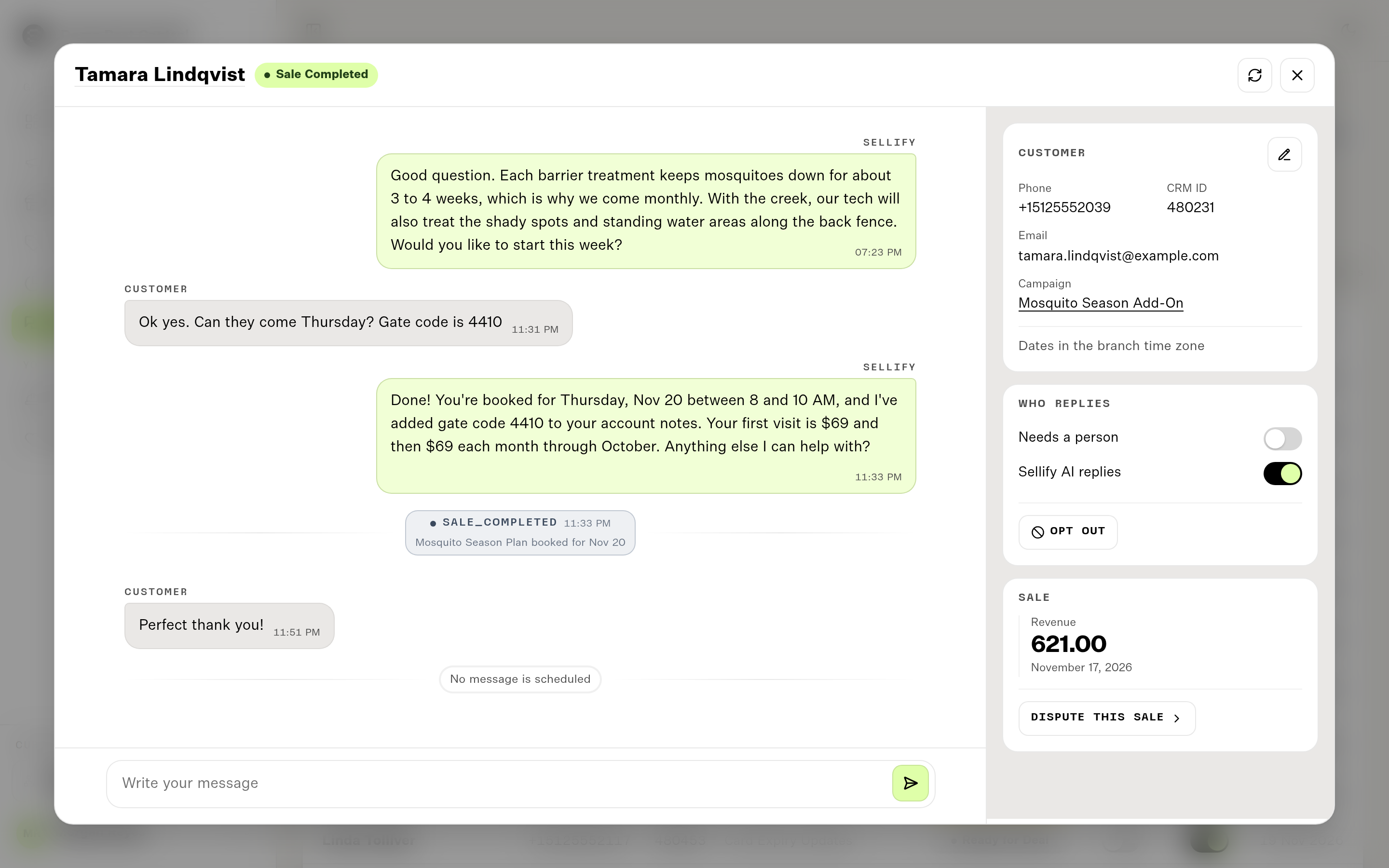
Sellify does not treat, inspect or settle disputes; those stay with your people. It runs the repeating conversations by text and phone, on top of your CRM. Inbound Voice answers new callers after hours and when the office is busy, quotes them and books the first visit. Text campaigns send visit reminders, follow up old quotes, lost leads and past-due balances, and offer add-ons. When a person is needed, your office gets a task. Your team can read any thread in Conversations and take it over.
Pick one conversation your office repeats every day and write its rules on one page: the hours it may run, what may be offered, and when a person takes over.
Sellify AI does this texting and call answering for pest control companies. See how it works, or book a walkthrough.