Getting this month right matters. The Bureau of Labor Statistics expects about 13,700 openings for pest control workers each year, many of them to replace workers who leave (BLS, 2025). NPMA's workforce program names high rates of technician turnover as a challenge for the industry (NPMA). A new hire who feels lost in week two is a new hire you may be replacing by spring.
Before day 1: get ready
Do this the week before the start date, so day 1 is about the work and not about paperwork.
Score your company
Tick what is true today. The counter adds up as you go.
| Ticked | What to do next |
|---|---|
| 0 to 3 | Delay the start by a few days if you can. Day 1 without labels, a trainer or a truck sends the wrong message. Use the waiting time to read Pest control technician retention: 7 habits that keep techs. |
| 4 to 7 | Start on time. Close the open items in week 1, starting with the 30-day plan below. |
| 8 to 10 | You are ready. Hand the new tech this plan on day 1 so they know what comes next, and see the Technicians hub for what to read after day 30. |
The 30-day plan
- Day 1
Welcome and safety
OfficeMeet the team, safety rules, the truck walk-around, and where to find labels and protocols. No customer visits yet, or one short ride-along.
- Days 2 to 5
Ride along and watch
TechnicianThe new tech rides with the trainer and writes down questions. The trainer explains each product choice and each note.
- Days 6 to 10
Do it, trainer watches
TechnicianThe new tech services the stops; the trainer watches and corrects on the spot. Service notes are written by the new tech.
- Days 11 to 15
Customer care
OfficePractice the hard moments: a customer who still sees pests, a balance to collect, a request for another service. Who to hand each one to.
- Days 16 to 25
Short solo routes
TechnicianShorter routes alone, with a check-in call at the end of each day. The trainer reviews notes and answers questions.
- Days 26 to 29
A full route
TechnicianA normal route alone. The office watches for customer complaints and passes on any praise.
- Day 30
The review
OfficeGo through the day 30 checklist below with the tech and the trainer. Agree on two things to keep doing and one to fix.
The day 30 review
Score the new technician together. One point per line.
- Knows where every label, SDS and protocol is, and uses them.
- Writes service notes the office can use without calling back.
- Explains to a customer what was done and what to expect.
- Hands price questions and add-on requests to the right person.
- Follows your payment-at-the-door policy.
- Has had no safety incident.
- Has had at least one customer compliment, or no open complaint.
- Knows who to call for each kind of problem.
Six or more: move to a full schedule with weekly check-ins. Fewer: extend the trainer's support by two weeks and say exactly why.
Three mistakes to avoid
Throwing them on a route in week 1. It saves a few days and costs you the hire. Customers notice, and so does the tech.
A trainer who is fast but impatient. Pick the tech whose customers like them. The new hire copies what they see.
Answers that live only in someone's head. If the only way to learn your re-service policy is to call one senior tech, the new tech will stop asking. Write it down.
Next, read Pest control technician retention: 7 habits that keep techs and Tipping pest control technicians: how to offer it fairly, and see more on the Technicians hub.
Questions
How long does it take to train a pest control technician?
Does this replace state certification?
Why plan the first 30 days at all?
If you use Sellify
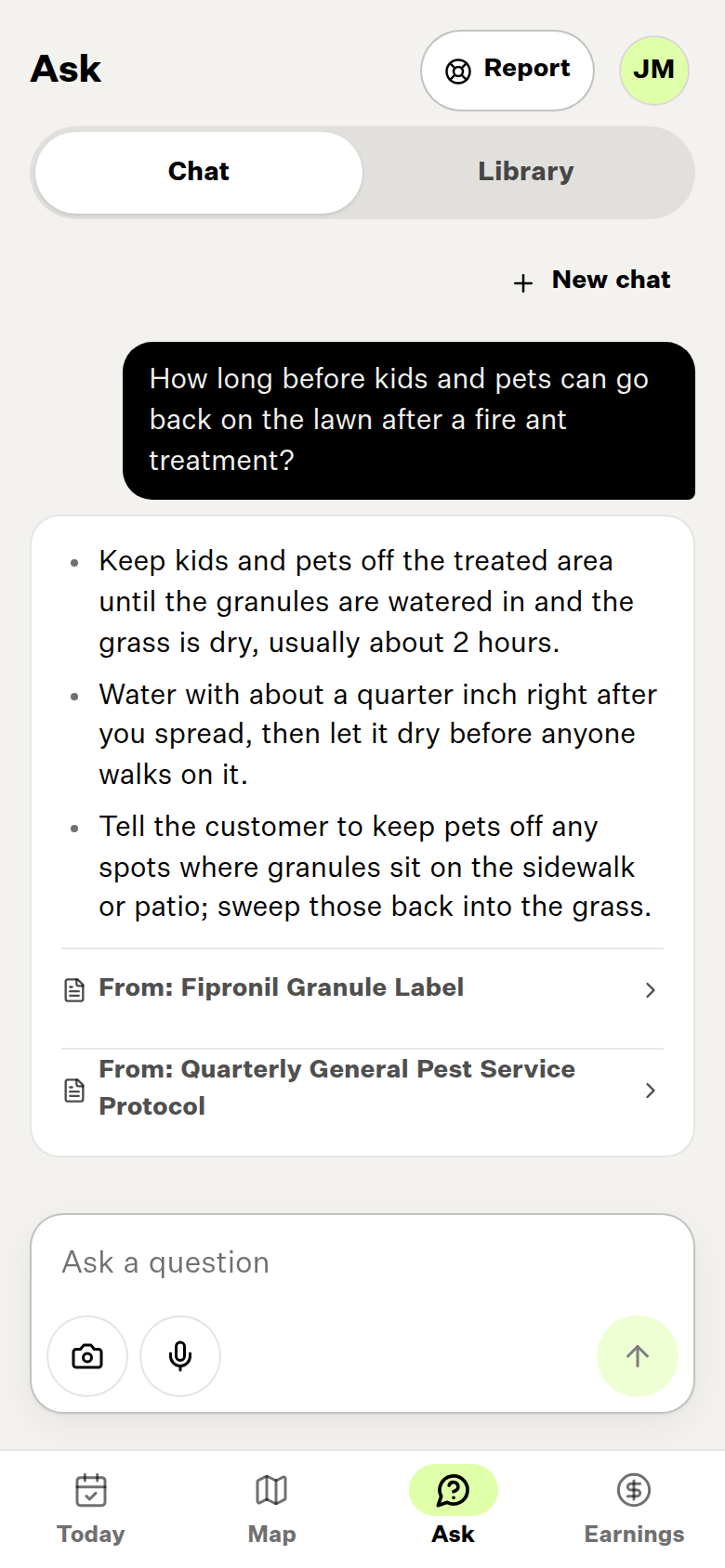
Sellify does not replace a trainer, a ride-along or your state's licensing. What it does: your office uploads labels, protocols and policies, and a new technician asks how-to questions on the phone, by text or voice, and gets answers from those documents. The same app shows the day's stops and what to know before each one. Customers' answers after each visit give the day 30 review a score per technician. If you are the new technician, read what the app shows you.
Put the day 30 review on the calendar for your newest hire, and write down the eight review lines from this guide so the trainer has them.
Sources
- Bureau of Labor Statistics: Occupational Outlook Handbook, Pest Control Workers
- NPMA: Workforce Development Program
- Sellify AI product documentation