Keeping customers is worth the effort. In research by Frederick Reichheld of Bain, cited by Harvard Business Review, a 5% rise in retention raised profits by 25% to 95% (Harvard Business Review, 2014). That research is not about pest control, but the direction holds for any recurring service.
Why the day after
- The visit is fresh. The customer remembers what the tech did and said.
- Some customers see pests right after a treatment and assume it failed. A quick reply that explains what to expect can calm that before it turns into a cancel.
- If the customer is unhappy, they may say so in public. 89% of consumers expect a business to respond to reviews (BrightLocal, 2026). It is easier to fix the problem in a text than to answer a one-star review.
Who does what: the path of one follow-up
Example: one follow-up done by hand at Demo Pest Control
Example data. Invented customer, technician and times.
- Day 0, 2 pm
Visit done
TechnicianInterior and exterior treatment for ants. The tech notes where activity was heaviest.
- Day 1, 10 am
One check-in text
OfficeThe office sends one short check-in to every customer visited yesterday.
- Day 1, 11 am
The customer replies
CustomerRates the visit 4 out of 10. Still sees ants by the kitchen sink.
- Day 1, 11:30 am
Call the same day
OfficeThe office manager calls, explains what to expect after a treatment, and books a return visit under the service agreement.
- Day 1, end of day
Log it
OfficeThe outcome goes into the account notes and onto a simple list: date, customer, tech, score, problem, fix.
- End of month
Read the list
OfficeTwo of the low scores are on the same route. The field manager rides along for a day.
The four rules
- One text, one day after. Not a survey. One question about the visit, one rating question.
- Every unhappy answer gets a call the same day. A text reply to a complaint is fine for scheduling. The apology works better by voice.
- Every answer goes on one list. Customer, technician, score, problem, fix. If it is not written down, it did not happen.
- Coach from the list, not the loudest call. Look at scores per technician once a month. Praise the patterns that work and fix the ones that do not.
What a good follow-up looks like
Aim for a check-in that reaches every customer the day after the visit, gets a reply from many of them, and turns every complaint into a same-day call. Keep it short and about the visit, so customers answer it. The point is to hear about a problem while a return visit can still fix it.
Watch four numbers each month:
- Reply rate: the share of customers who answer the check-in. A falling rate means it is too long or too late.
- Same-day calls: the share of unhappy replies that got a call the same day. Aim for all of them.
- Return visits: how many complaints ended in a return visit, and how many of those customers were still on service a month later.
- Score per technician: the average rating per tech, read next to their route, not alone.
Questions for the call
When a customer is unhappy, ask before you offer:
- What are you seeing, and where?
- When did you first notice it?
- Did the technician explain what to expect?
- What would make this right for you?
Then do one thing you can promise and keep it. Book the return visit, send the field manager, or credit the visit if your policy allows it.
Where to go next
When a customer asks to cancel anyway, see Pest control cancellation: what to do in the next hour. For the before-the-visit side, see Pest control appointment reminders customers answer. The full picture is in How to keep recurring pest control customers, and more for your team is on the Office and customer service hub.
Questions
When should I follow up after a pest control treatment?
What should the follow-up ask?
What do I do when a customer says the pests are still there?
Why not just ask for a review?
If you use Sellify
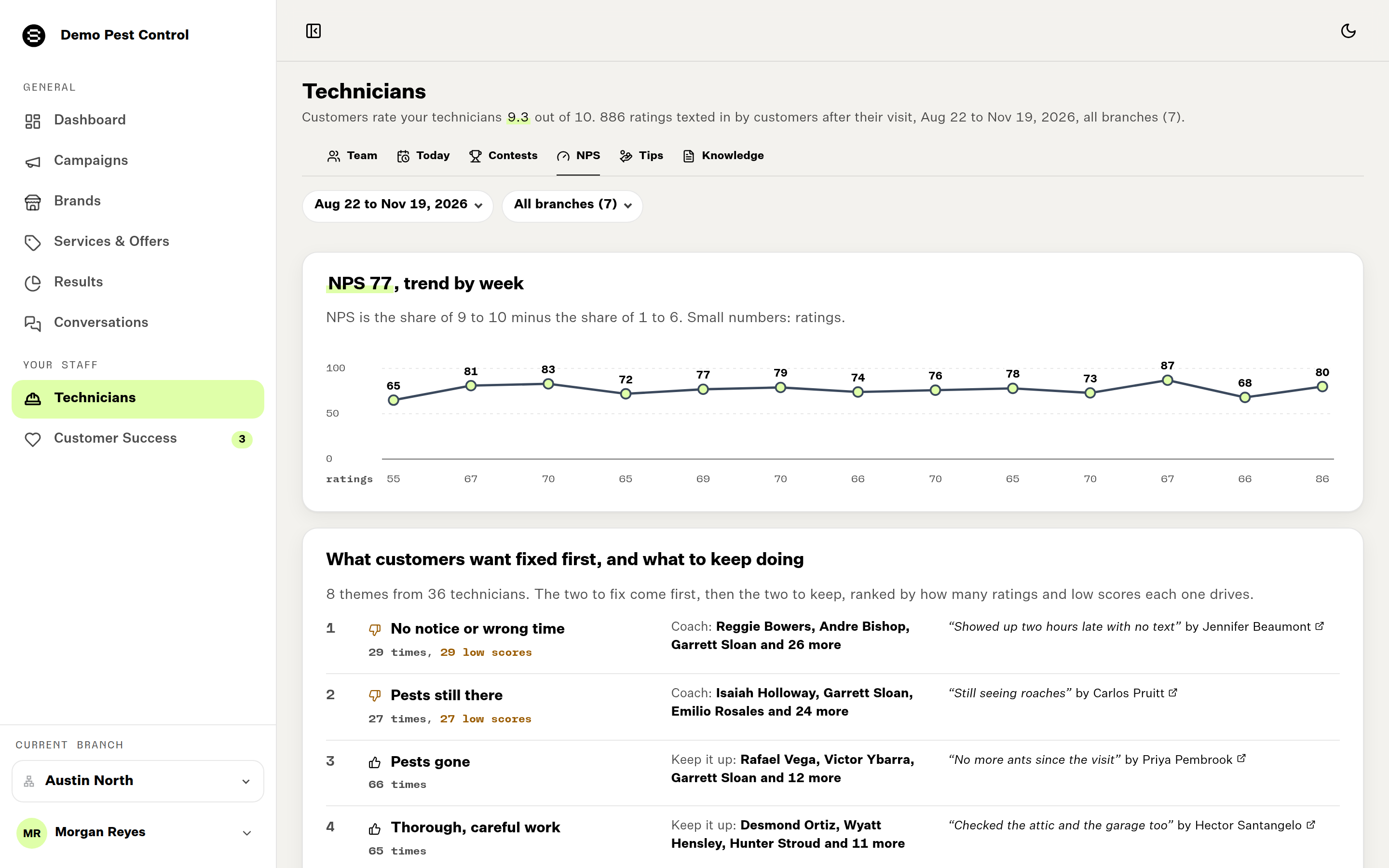
Sellify does not book the return visit or make the apology call; your office does both. Where your office turns on the follow-up after the visit in a reminder campaign, Sellify checks in with the customer the day after the visit and collects a rating. A complaint becomes a task for your office with the customer's message and a summary. The ratings add up to a score per technician in Technician NPS, with what customers want kept and fixed. Your office can read or take over any follow-up.
Check in with everyone you serviced yesterday, and call each unhappy customer back before the end of the day.
Sellify AI does this texting and call answering for pest control companies. See how it works, or book a walkthrough.