Our position: a save attempt is worth one honest call, not a hard sell. It does not apply when the customer is moving out of your area or has sold the home; confirm those kindly and ask for a referral.
The first hour, step by step
- Put a name on it. One person owns every cancel request from the moment it arrives, by phone, text or email.
- Read the account before you call. Last visits, open complaints, balance, how long they have been a customer.
- Call, do not reply by email. Ask one open question about what changed, then let them talk.
- Listen for the real reason. A price complaint often hides a service problem: still seeing pests and still paying.
- Answer that reason with one offer you can keep. Decide in advance what your office may offer, so every caller hears the same thing.
- Confirm in writing, whether they stay or go.
- Log the reason in one list: date, customer, reason, offer, outcome. Read it once a month.
What good looks like
Aim for a cancel request that never waits overnight, a reason written down for every one, and an answer that fits that reason. A customer who still sees pests needs a visit, not a discount. A customer who is moving needs a kind confirmation, not a sales pitch. When the customer leaves, they get a clear confirmation in writing with the cancel date, the last visit, any open balance and how to restart.
Numbers to watch each month:
- Time to first call back: hours from the request to a real conversation. Same day is the floor.
- Saved cancels: the share of requests that end with the customer staying, split by reason.
- Reasons: the count per reason, per route and per technician. One route or one month often explains half the list.
- Discounts given: if saves only come with a discount, the problem is the service, not the price.
What to avoid
- Waiting a day. A customer who asked to cancel and heard nothing has made up their mind.
- Leading with a discount. It teaches customers to threaten to cancel.
- Arguing about the reason. Your job in the first hour is to understand it.
- Forgetting the log. Without it, you cannot see that half your cancels come from one route or one month.
Where to go next
To find problems before the cancel call, see Pest control follow-up after treatment. For customers who already left, see How to win back canceled pest control customers. For the whole queue, see Pest control office handoffs: run them as one queue. The pillar is How to keep recurring pest control customers, and the Office and customer service hub has the rest.
Questions
How fast should we respond to a cancel request?
Should we always try to save the customer?
Should I charge a cancellation fee?
What should a pest control cancellation letter include?
If you use Sellify
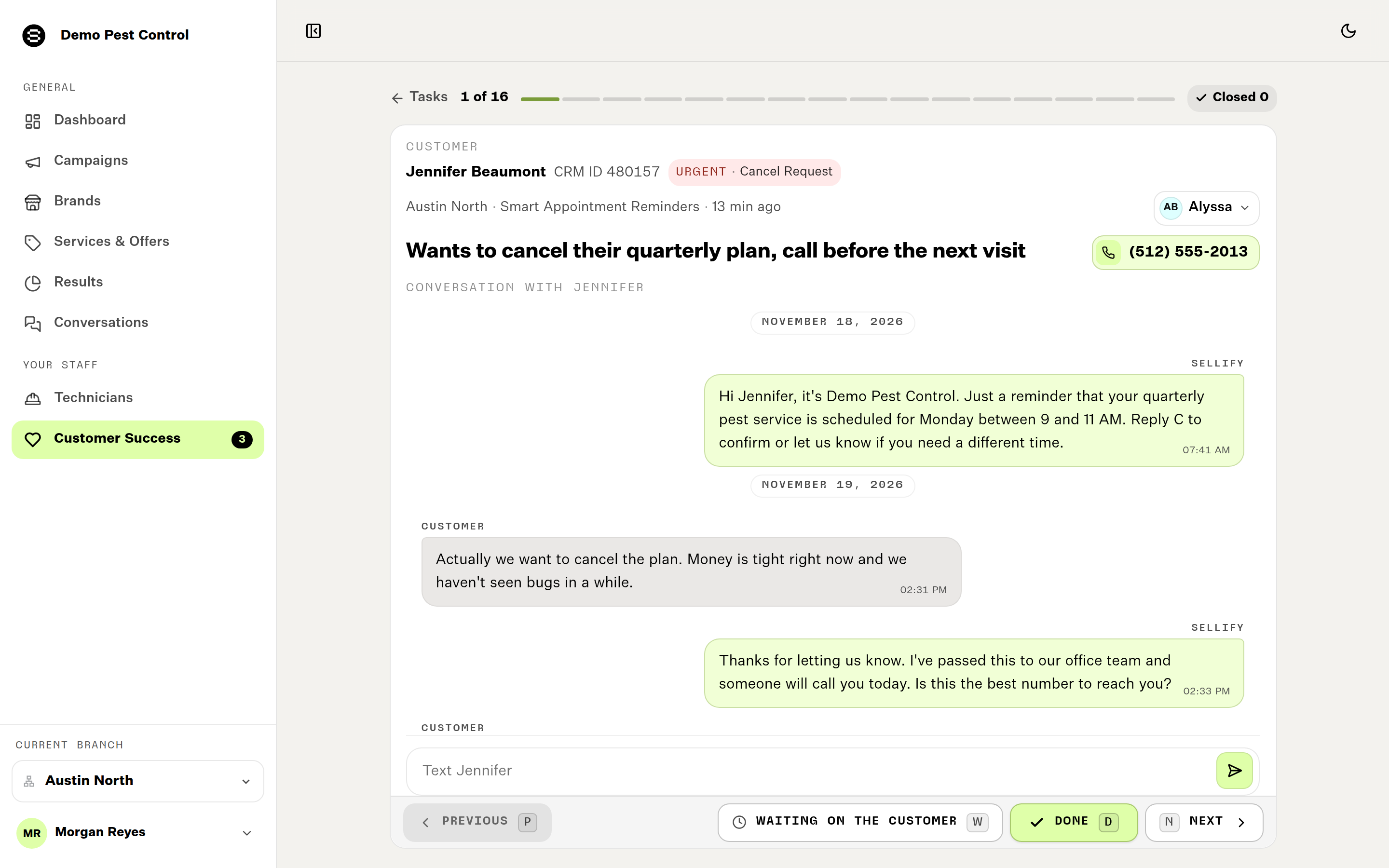
Sellify does not make the save call; a person in your office does. When a customer texts that they want to cancel, Sellify puts it on your office task list with the conversation and account details, assigned to someone in the right branch. Your team calls or texts from the task and marks it done when it is settled. Later, Win Backs reaches customers who left, so the door you kept open gets used. See Customer Success Tasks and Sentiment, which shows the themes behind unhappy customers.
Pick one person who owns every cancel request, and start a one-line log: date, customer, reason, offer, outcome.
Sellify AI does this texting and call answering for pest control companies. See how it works, or book a walkthrough.