This guide is about the customers on your route. Keeping them and winning new ones are two separate jobs, and a company needs both. If your trouble is new callers who never book, start with Pest control leads: from first call to first visit instead.
How much of the business is recurring
Recurring work in US pest control
Share, %| Item | Value | Source |
|---|---|---|
| Recurring share of residential service revenue, 2025 | 85.4% | Specialty Consultants via NPMA, 2026 |
| Recurring share of residential service revenue, 2024 | 85.2% | Specialty Consultants via NPMA, 2026 |
| Recurring share of total income, 2025 cost study sample of 246 firms | 74% | NPMA and PCO Bookkeepers 2025 Cost Study |
The first two bars cover residential service revenue across the industry. The third is the recurring share of total income for the firms in one cost study. Different measures, same message: most of the money is already on the route.
Where customers slip away
Watch four moments:
- A visit that goes wrong. Nobody home, a locked gate, a dog in the yard. A paid visit becomes a skipped one, and the customer wonders what they pay for.
- A problem that comes back. Ants return two weeks after service. If nobody asks, the customer decides on their own.
- A payment that fails. An autopay card expires. The customer did nothing wrong, but now they owe money and get a call about it.
- A cancel nobody follows up. The customer calls to cancel, the office processes it, and nobody asks why.
Six habits that keep customers on service
- 1
Confirm every visit before it happens.
Text the customer ahead of each visit and let them answer. Confirm, move or leave a note. A two-minute exchange saves a wasted trip.
- 2
Pass the notes to the technician.
Gate codes, pets and "please treat the garage" only help if the tech sees them before the stop. Put them in the CRM record the tech opens, not in someone's inbox.
- 3
Check in after the service.
Within a few days of the visit, find out whether the problem is gone. A customer who still sees pests today can still be saved with a re-service. A customer who says nothing may cancel before the next visit.
- 4
Give every problem an owner.
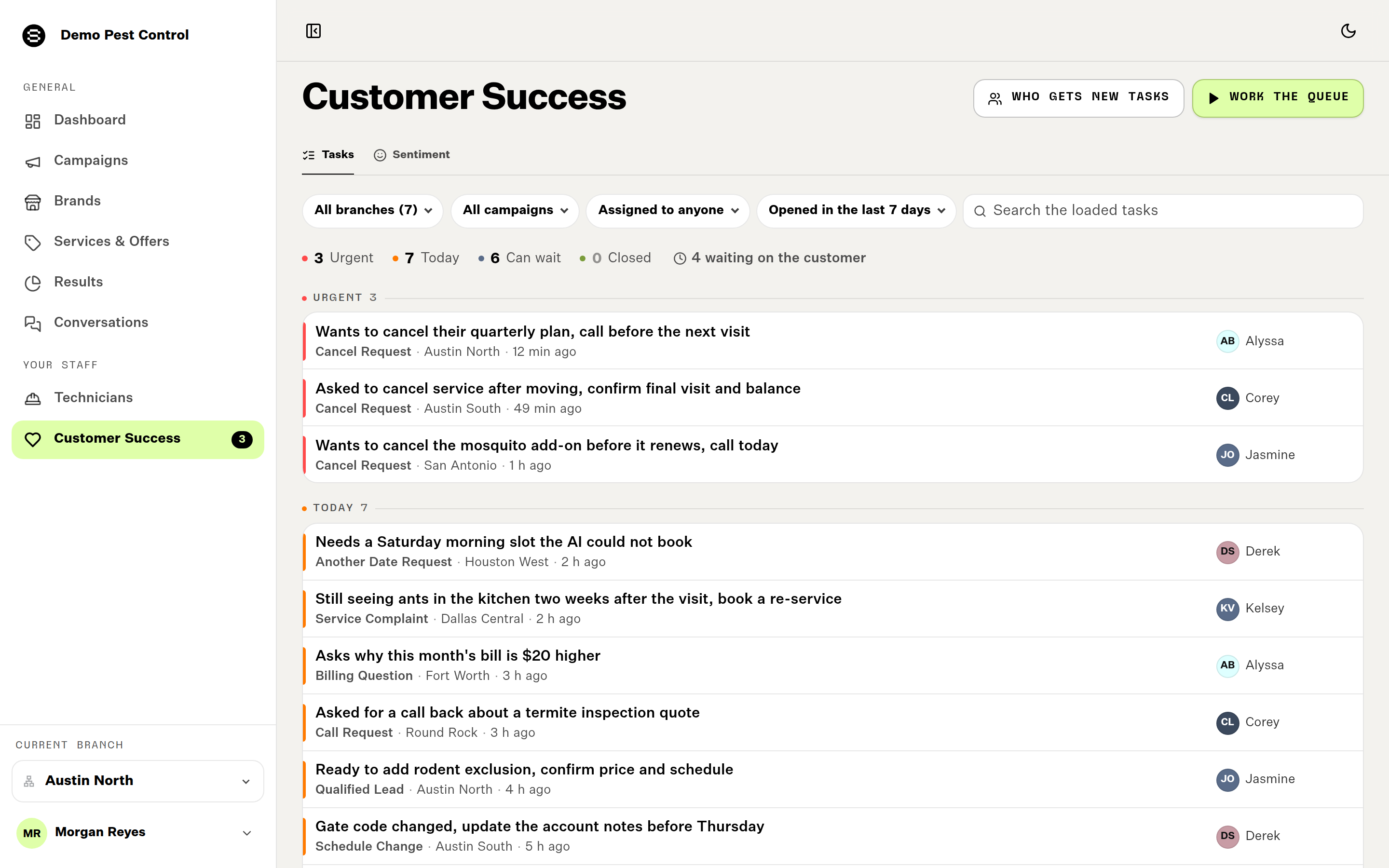
Put complaints, cancel requests and callbacks in one list, sorted by urgency. Each item has a name next to it and a status. Cancel requests go to the top.
- 5
Catch cards before they fail.
Each month, list the autopay cards that expire that month and ask those customers to update their card through your CRM's secure link. Never take a card number by text. In one survey of subscribers, 27% said they were likely to cancel after an avoidable failed payment, such as an expired card (PYMNTS Intelligence and FlexPay, vendor-sponsored, 2023). That survey covered subscription businesses, not pest control, but autopay plans fail the same way.
- 6
Ask why people leave, then go back.
Write down the reason for every cancel. Read the list once a month with your managers. Then contact past customers, ask what went wrong, and make a fair offer where the reason was fixable.
None of this needs special tools. It needs someone to do it every day. That is the hard part. If you run a small route and know each customer by name, habits 1 and 3 may be enough; the list in habit 4 matters once more than one person answers the phone.
Score your retention habits
Tick what is true for your company today. Be strict: "sometimes" counts as no.
Score your company
Tick what is true today. The counter adds up as you go.
| Ticked | What to do next |
|---|---|
| 0 to 3 | Start with habits 1 and 4. Reminders and one owned list stop the most avoidable losses. Next: appointment reminders customers answer. |
| 4 to 7 | Add the after-service check-in and the monthly cancel review. They show you problems while you can still fix them. Next: the follow-up after service. |
| 8 to 10 | Keep it running every day, and measure: cancels per month, saved cancels, and failed autopay charges. Next: win back customers who left. |
A weekly rhythm that keeps it going
- Every morning: work the problem list, cancel requests first.
- Every day: reminders out, check-ins out, notes passed to the route.
- First of the month: pull the cards that expire this month.
- Once a month: read the cancel reasons with your managers and pick one thing to fix.
- Once a quarter: reach out to customers who left, with an offer that answers the reason they gave.
Related guides
Owners
For pest control business owners: where the next customer comes from, who is about to leave, what each part of the business returns, and how to run branches.
How to win back canceled pest control customers
A step-by-step way to win back canceled pest control customers: sort the cancel list, ask what went wrong first, make a fair offer and close it in one thread.
The follow-up after service: catch problems before a cancel
A next-day follow-up after every pest control treatment finds unhappy customers before they cancel. A timeline, a call plan and the numbers to watch monthly.
A customer wants to cancel: what to do in the next hour
What to do in the first hour after a pest control customer asks to cancel: find the real reason, answer it, confirm it in writing and log every cancel.
Expired cards: the quiet way autopay customers leave
Expired cards turn autopay pest control customers into past-due balances and cancels. A monthly routine to catch them, with a worked example for your numbers.
Questions
What share of pest control revenue is recurring?
Do these steps need software?
Where do most recurring customers slip away?
If you use Sellify
Sellify does not run your route or fix a visit that went wrong; your team still does that. It covers the texts around the visit. It sends a reminder the customer can answer, and the gate, pet and access notes they send are written to your CRM for the technician. Where your office turns it on, it checks in the day after the service. A complaint, a cancel request or a callback becomes a task for someone in your office. It also texts autopay customers whose card expires that month, with your CRM's own secure link. See Smart Reminders, Customer Success Tasks and Expiring Credit Cards.
Pull the list of everyone who canceled in the last 90 days and write one reason next to each name.
Sellify AI does this texting and call answering for pest control companies. See how it works, or book a walkthrough.