Pay is not the only reason a technician stays or leaves, but it is the first thing they compare. A tech who earns less than the shop down the road, and cannot see why, takes the next recruiter's call.
How hard is it to hire and keep technicians?
The labor pool is small. The Bureau of Labor Statistics counts 108,700 pest control worker jobs (2025). It projects 6% job growth from 2025 to 2035 and about 13,700 openings a year, many of them to replace workers who leave (BLS, 2025). Owners feel it.
What pest control owners and leaders say about staff, 2025
Share, %| Item | Value | Source |
|---|---|---|
| Name recruiting and keeping employees as a goal | 45% | Thrive Analytics, 2025 State of the Pest Industry |
| Name recruiting and keeping employees as a threat | 43% | Thrive Analytics, 2025 State of the Pest Industry |
| Said too few technicians held back growth | 36.8% | Specialty Consultants via NPMA, 2026 |
| Kept technician pay the same as in 2024 | 11% | Thrive Analytics, 2025 State of the Pest Industry |
The first, second and fourth bars come from a vendor-sponsored survey of 1,025 pest control leaders in April 2025 (Thrive Analytics, 2025). The third comes from a survey of 800 owners and managers about 2025 (Specialty Consultants via NPMA, 2026). In the first survey, only 11% left technician pay unchanged from 2024 (Thrive Analytics, 2025). If you held pay flat, you are in the minority, and your techs may be comparing you with companies that did not.
How do you set your own pay rate?
Start with three numbers.
- The national median. $45,250 a year, or $21.75 an hour (BLS, 2025).
- Local job ads. Read ten ads from companies within an hour's drive, including lawn care and HVAC. Those are your real rivals for the same people.
- Your margin. Direct labor runs about 25.8% of revenue in the 2025 cost study of 246 pest control firms (NPMA and PCO Bookkeepers cost study, 2025). If your labor share is far above that, fix routes and pricing before you add pay. If it is far below, you may have room.
Then set bands, not single numbers: a starting rate, a rate after licensing, and a senior rate. A band tells a tech where they are and where they can go.
Hourly, salary or production pay: which fits your company?
Each model works somewhere, and each has a risk you have to manage. Open the answer that fits your routes.
Open the answer that fits. Each path ends in one action.
What fills most of your technicians' days?
Recurring residential stops on steady routes
Is the technician new or experienced?
New, in the first year
Do thisPay hourly with a written raise schedule tied to licensing and training. Risk: hourly pay does not reward speed, so check stops per day and call-backs each month.
Experienced and licensed
Do thisConsider production pay, a share of the revenue serviced, with a guaranteed hourly floor. Risk: rushed stops and more call-backs, so track re-services per tech and check wage and overtime rules with your accountant.
A mix: inspections, one-time jobs, termite and specialty work
Does your work drop a lot in winter?
Yes, we have a slow season
Do thisPay hourly with guaranteed minimum weekly hours in the slow months. Risk: the guarantee costs you in quiet weeks, but pay that collapses every winter sends techs looking elsewhere.
No, it is steady all year
Do thisPay hourly or salary, plus a small bonus tied to quality, such as call-backs or customer ratings. Risk: salaried weeks that run long feel unpaid, so track hours and check overtime rules before you put anyone on salary.
Mostly commercial accounts on set schedules
Do thisPay hourly or salary with a premium for night or weekend work and for audit-ready paperwork. Risk: commercial techs are hard to replace, so review their rate against the market at least once a year.
Whatever you pick, write it down and give every technician the same document. Two techs on the same route with different deals they cannot explain is how trust goes.
What do techs count besides the hourly rate?
Techs compare the whole job, not only the rate. Before you raise pay, check what else you offer and whether your techs know about it.
- The vehicle. A company truck they can take home saves them real money each month.
- Hours. Predictable hours and a set day off matter more to many techs than a dollar an hour.
- The phone. A company phone, or a monthly allowance for their own.
- Licensing paid by the company. Exam fees, study time and continuing education hours.
- A predictable route. Fewer long drives, fair share of hard stops, and the same customers week to week.
- Health insurance and paid time off, if you offer them. Put a dollar value next to each when you talk pay.
How do you show pay is fair?
Fair pay is pay a tech can check. Three things do most of the work:
- Written bands for each role, shared with every tech.
- A review date that everyone knows, such as each spring before the busy season.
- Clear reasons to move up: a license, a year without call-back problems, training a new hire, good customer ratings.
Customer feedback is a fair input if it is the same for everyone. Ask each customer the same question after the visit and work out a score per tech. More habits that keep good techs are in Pest control technician retention: 7 habits that keep techs, and a plan for new hires is in Pest control technician training: first 30 days checklist.
Do tips and bonuses belong in pay?
Tips do not. A tip is the technician's money, given by a customer who wanted to say thanks. Set pay so it is fair without tips. Never count tips toward a wage or lower a rate because a route tips well. How to offer tipping without making it awkward is in Tipping pest control technicians: how to offer it fairly.
Bonuses and contests are extras on top of pay. They work when they reward something the tech controls, such as customer ratings or jobs done, and when every route has a fair chance. They do not fix a base rate that is too low.
Is a raise cheaper than an open route?
Often, yes. Here is the math for one technician at Demo Pest Control. Every input except the margin is an assumption for the example.
A raise of $1 an hour for one full-time tech costs about $2,080 a year (2,080 hours). Payroll taxes add a little on top. Now say that tech leaves, and the route sits open for eight weeks while you hire and train. If the route brings in $2,500 of revenue a week, that is $20,000 of work that is late, moved to overtime or lost. At the 58% gross margin in the 2025 cost study (NPMA and PCO Bookkeepers cost study, 2025), the gross profit at risk is about $11,600, before the cost of hiring and training the replacement.
A raise does not guarantee anyone stays. But if a dollar an hour is the gap between you and the next company, it is the cheaper side of the bet. Run the same math with your own route revenue. See all technician guides in the Technicians hub.
Questions
How much do pest control technicians make?
How many pest control technician jobs are there?
Should tips count as part of a technician's pay?
Is production pay a good idea for pest control technicians?
If you use Sellify
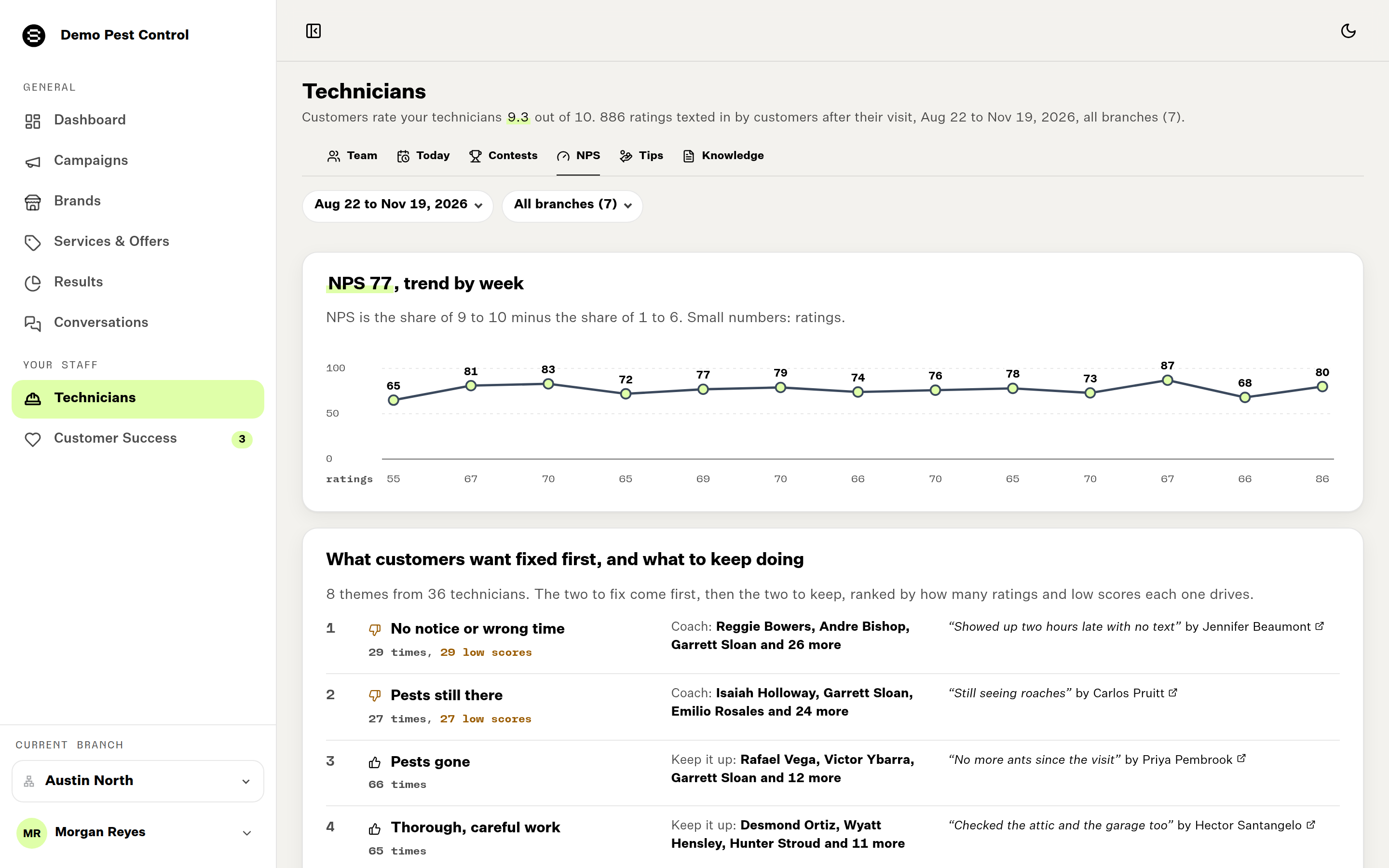
Sellify does not run payroll or set pay. It covers a few extras around it. Customers can tip their technician from a text after the visit, and the money goes to the technician. You can run monthly contests on ratings or jobs done, with prizes paid to the winners. A score per technician comes from customers' answers after each visit, which gives you a fair basis for a bonus. Technicians see their tips and prize money in a phone app.
Write down the pay band for each technician role, the date of the next pay review, and two things that move a tech up a band. Share it with your techs.
Sources
- Bureau of Labor Statistics: Occupational Outlook Handbook, Pest Control Workers
- NPMA: US pest control industry sustains steady growth with 6% increase in 2025
- NPMA and PCO Bookkeepers: 2025 pest control industry cost study
- Thrive Analytics (vendor-sponsored): 2025 State of the Pest Industry, a survey of 1,025 pest control leaders
- Sellify AI product documentation