Why it matters: about 80% of small firms report challenges tied to payments, and customer payments are "the primary source of cash available to small businesses" (Federal Reserve Banks, 2024). That survey covers all small firms, not only pest control, and its "challenges" include more than late payers. But every owner knows the pattern: the visit is done, the cost is spent, and the money has not come in.
Our position: treat a past-due balance as a customer to keep until the agreement says otherwise. It does not apply to a customer who has stopped answering after your stop point; at that stage, take the step your agreement describes.
Part of the Billing and collections hub.
Why balances go past due
Most past-due customers are not refusing to pay. In a recurring service business, balances usually age for ordinary reasons:
- The card failed and nobody told the customer. (See expired cards and failed autopay.)
- The invoice never reached them, or went to an old email address.
- They are waiting for payday.
- They are unhappy with the service and are paying by not paying.
- They think they already paid.
Each one needs a different answer. That is why a single form letter at 60 days does so little.
Seven steps that work with a phone and a spreadsheet
- 1
Pull the list every week.
From your CRM, export every account with an open balance: name, phone, amount, age, last visit, last contact. Sort by age. One person owns this list.
- 2
Make the first contact early and friendly.
A text from your company's number, with the amount and a link to pay, sent shortly after the balance is past due. Early contact is about the customer remembering the visit, not about pressure.
- 3
Make paying one tap.
A secure payment link beats asking the customer to call the office during business hours. Never ask a customer to send a card number by text.
- 4
Listen for the reason.
The reply tells you which of the five reasons you are dealing with. A wrong charge or a claim that it is already paid goes to a person; a cancel request is handled as a cancel first, with the balance kept as a separate conversation.
- 5
Offer a payment plan when someone wants to pay but cannot.
Keep it short and specific: two or three payments, dates written down, and a confirmation sent the same day. Decide your limits in advance (smallest balance you will split, longest plan you will allow) so every caller gets the same answer.
- 6
Give disputes to a person.
Someone who can open the visit record, the technician's notes and the payment history. Do not argue a dispute by text.
- 7
Decide your stop point in advance.
How old can a balance get before you stop texting, pause service or refer it to an agency? Write it into your service agreement so the customer knows before it happens.
Can a pest control company send a balance to collections?
Many do, as the last step. When and how depends on your own service agreement and on the rules in your state, so ask your attorney before you set the policy. This guide is not legal advice. From the customer's side, the agency step is where a relationship usually ends, so the steps above are about collecting before you get there.
What good looks like
Aim for a short list that stays short: balances contacted while the customer still remembers the visit, paid with one tap, and the hard cases in a person's hands the same day. A good week ends with most new balances paid, every payment plan confirmed in writing, every dispute owned by someone who can open the visit record, and no customer lost over an amount they never knew they owed.
Numbers to watch each week:
- Balance age: total owed by 0 to 30, 31 to 60 and 61+ days. The oldest bucket should shrink.
- Paid after first contact: the share of balances settled without a second reminder.
- Plans kept: payment plans paid on the agreed dates.
- Disputes and "already paid" replies: how many, and how fast a person answers them.
- Cancels that start on the balance list: if this grows, look at service quality on those accounts.
Where to go next
More reading: A customer wants to cancel: what to do in the next hour and How to keep recurring pest control customers.
Questions
Should a pest control company offer payment plans?
Can a pest control company send an unpaid balance to collections?
Should we stop service when a balance is past due?
What do we do when a customer says they already paid?
If you use Sellify
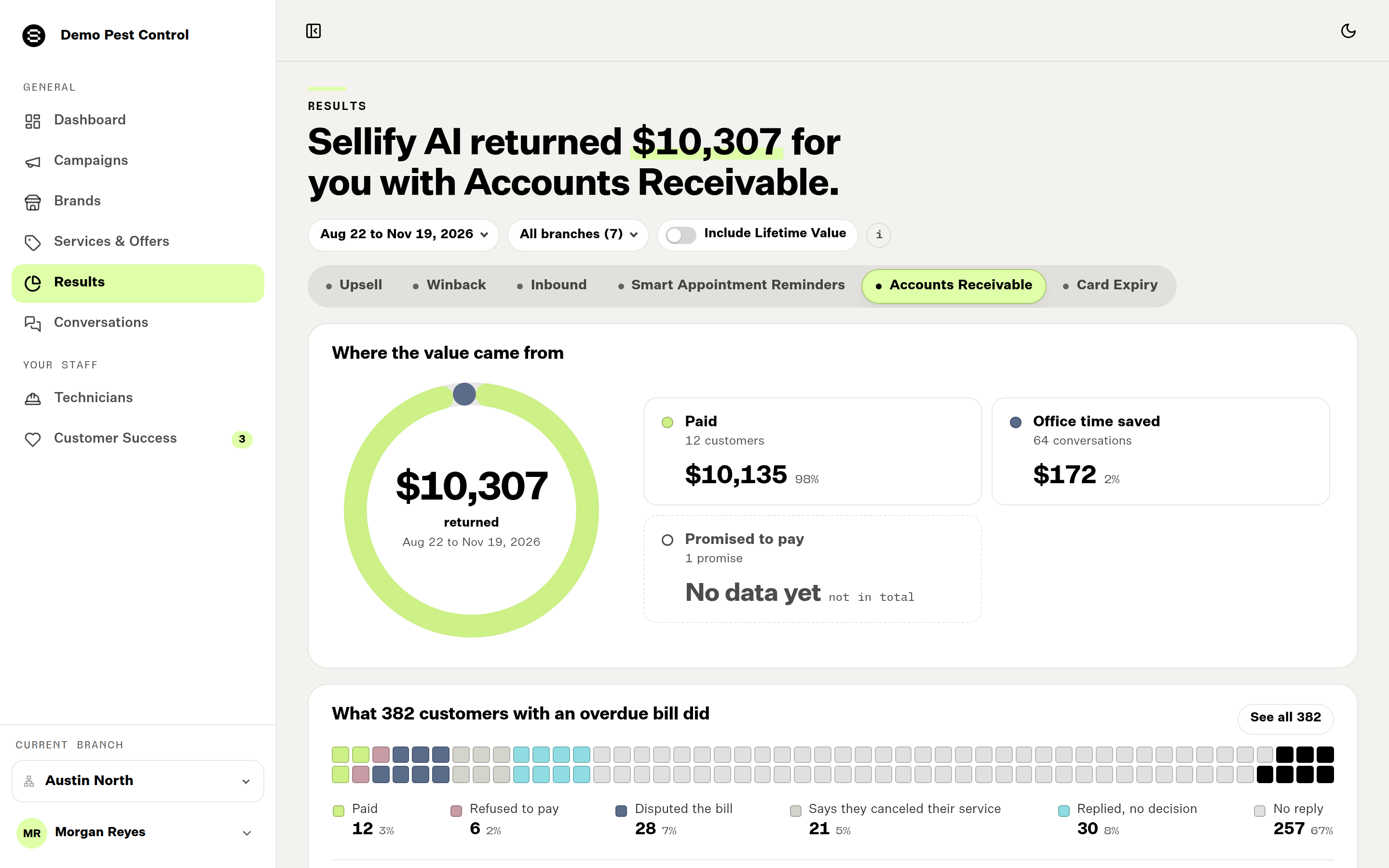
Sellify does not decide when to pause service or send a balance to an agency; that stays in your agreement. Accounts Receivable texts customers with a past-due balance and a secure pay link, and where your CRM supports it they can say yes to paying with the card on file. Sellify follows up while the balance is open, within the limits you set. Disputes go to a person on your team as tasks. Results shows who paid, disputed or refused. It runs as one campaign for your whole organization, and you choose the branches it covers.
Export every account with an open balance, sort it by age, name one owner for the list, and contact the newest balances first.
Sellify AI does this texting and call answering for pest control companies. See how it works, or book a walkthrough.